Research

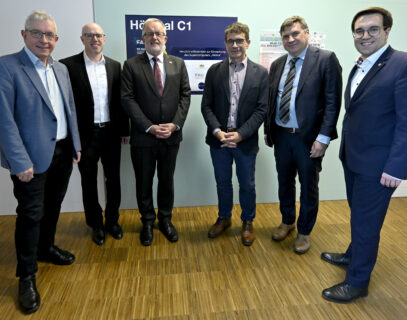
State-of-the-art technology for research: The Center for National High Performance Computing Erlangen at Friedrich-Alexander-Universität Erlangen-Nürnberg (NHR@FAU) has officially inaugurated the currently most powerful supercomputer at universities in Germany with a festive colloquium.

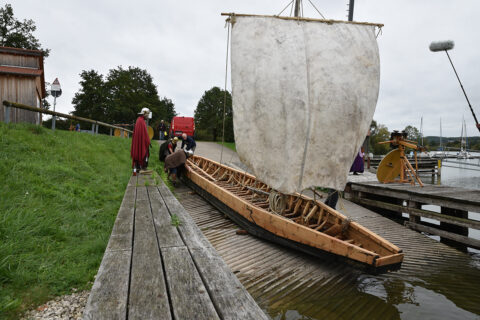
After three years on the Danube, the Danuvia alacris, FAU's second Roman boat, is returning home to the shipyard in Schlungenhof on Lake Altmühl for around seven months to undergo a general overhaul. The latest boat in the FAU fleet was also launched, the Alchmona rediviva, Latin for revitalized Altmühl.

No more reels, no more selfies with funny filters, no more heated comment columns. Silence in the digital space. The debate about a social media ban for minors is also gaining momentum in Germany. However, FAU experts speak out against a social media ban for minors.

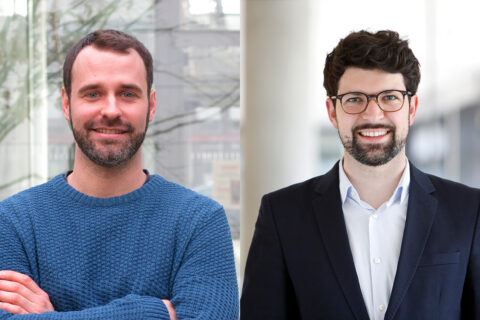
Dr. Carlos L. Bassani with the project “Kinetic Pathways to Control Nanocrystal Shapes” (kineticSHAPES) and Prof. Dr. Adrian Meier with the project “Social Well-Being from Hybrid Interactions in Hybrid Work” (HYIHY) have each been awarded a Starting Grant from the European Research Council (ERC) and will receive €1.5 million in funding each.

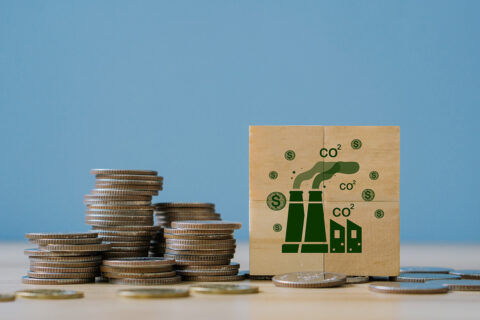
Many national CO2 taxes are too low to effectively reduce emissions and primarily serve symbolic and fiscal goals. This is shown by a recent study by energy policy researchers from FAU, the University of Potsdam and the Research Institute for Sustainability (RIFS) at the GFZ Helmholtz Center for Geosciences Potsdam.

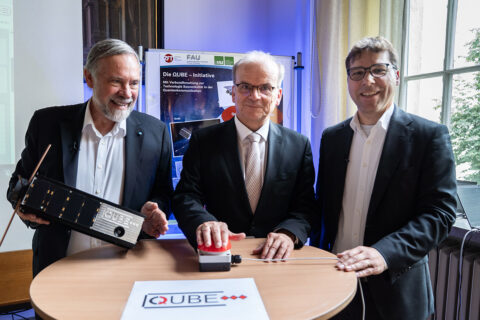
The QUBE research mission funded by the Federal Ministry of Research, Technology and Space (BMFTR), in which FAU researchers are also involved, will test newly developed quantum communication technologies in space for the first time using miniature satellites. This will lay the foundation for ensuring the tap-proof, worldwide transmission of data in the future.