Research

Crohn's disease is a chronic inflammatory bowel disease in which patients suffer from frequent diarrhoea and painful stomach cramps, making it difficult to lead a normal life. Doctors at FAU have recently tested a new treatment for this disease.

Increased salt intake comes with an increased risk of suffering a heart attack or stroke. However, high salt levels in the skin can in fact have a positive effect as they protect the body from microbial invasion.

Ten years ago, a team of astrophysicists led by researchers at FAU discovered an inconspicuous star in our galaxy, US 708, that turned out to be moving incredibly fast. Based on new observations that the FAU team were involved in, the cause of its extreme speed has now been identified.
Medical researchers at FAU have recently discovered a molecular mechanism which could hold the key to new treatments for fibrosis.

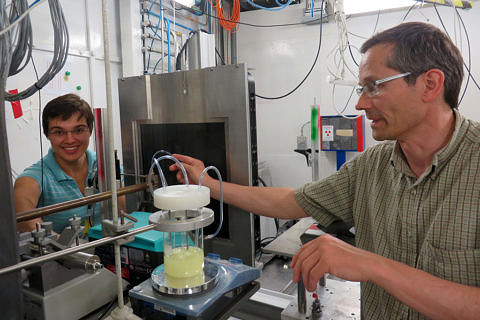
They have become part of our daily lives almost without us noticing – nanoparticles are responsible for unique properties in cosmetics, food and medication, but also in catalysts. Until recently researchers were only able to use theoretical modelling to show whether and how the internal structure of a liquid changes at the surface of a nanoparticle. Physicists at FAU have now been able to prove this in an experiment for the first time.

What should production processes look like in order to integrate systems which transmit data using light into existing components in the best possible way? This is the main research question that a newly established DFG Research Unit will be investigating. Researchers at FAU will play a key role in the Research Unit.

Since 2011, the Australian Dr. Clancy James has worked as a scientist in the projects ANTARES and KM3NeT at the Erlangen Center for Astroparticle Physics (ECAP). He is chair of the ANTARES Publications Committee and the future head of the Simulations Follow-Up Experimental Unit KM3NeT. In addition to his own research, Clancy James is a supervisor for doctoral candidates and students at the ECAP.

How does the sugar get into the beet? This question has been investigated by researchers at FAU's Division of Molecular Plant Physiology in collaboration with colleagues from the universities of Kaiserslautern, Cologne and Würzburg, and the companies Südzucker AG and KWS Saat AG.