Research

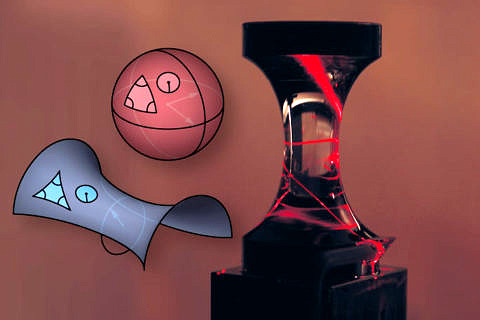
In a recent issue of the renowned journal Nature Photonics, physicists at FAU and Friedrich Schiller University Jena find the answers to astronomical questions in the laboratory, shifting the focus to a previously underappreciated material property – surface curvature.

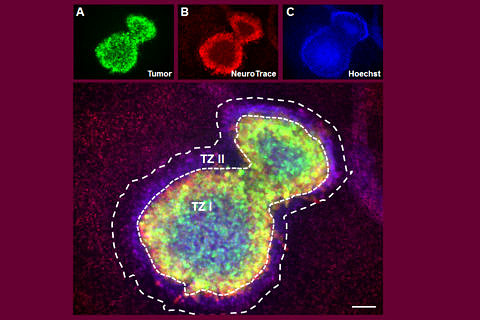
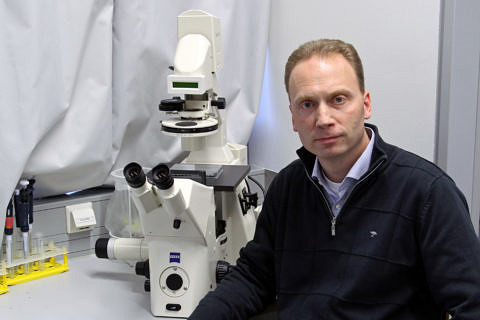
A new cell culture technique allows the processes of tumour growth to be studied directly and in real time, without the need for complex experiments using live animals. The researchers at FAU who developed the technique looked specifically at brain tumours.

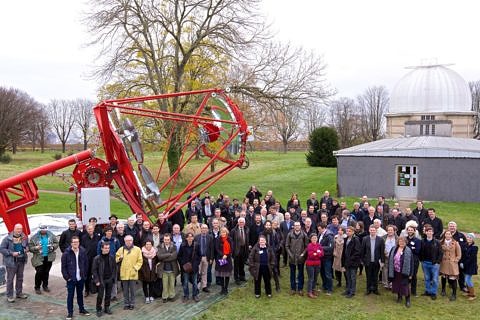
At the beginning of December, an international team of researchers, including members from FAU, celebrated the inauguration of the prototype Gamma-ray Cherenkov Telescope (GCT), which was developed for the Cherenkov Telescope Array (CTA), at the Observatoire de Paris in Meudon.
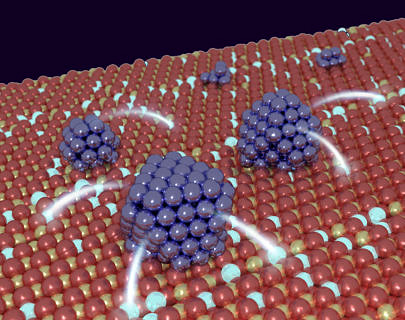
How nanoparticles give electrons away: Researchers have investigated how much electrical charge nanoparticles transfer to their support for the first time.

How does the mother-of-pearl in clam shells form? Not in a crystallisation process but through the aggregation of nanoparticles within an organic matrix – as materials scientists at FAU have now shown.

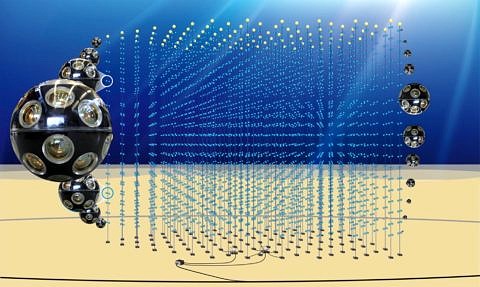
In the early morning of December 3 scientists and engineers from nine European countries started the installation of KM3NeT, the largest detector of neutrinos in the Northern Hemisphere.

Mit Zucker lassen sich besonders wirksame Antikörper formen. Wie das geht, das haben Wissenschaftler der FAU mit Forschern aus Schweden und Kroatien herausgefunden und im Fachjournal „Cell Reports“ veröffentlicht.

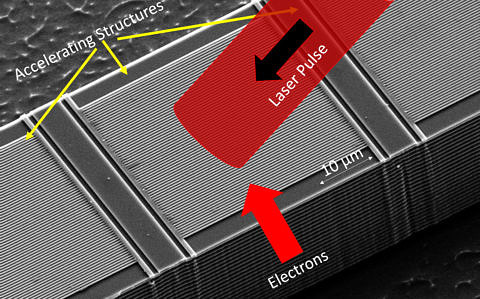
To build a particle accelerator the size of a shoe box – this is the goal of a research team being led by FAU and Stanford University in collaboration with eight international partners. The Gordon and Betty Moore Foundation is funding the project for the next five years with 13.5 million US dollars (approximately 12.5 million euros).