The influence of rapid climate change on biodiversity depends to a significant extent on longer-lasting climate trends in previous periods of the Earth’s history.
Although patients with human immunodeficiency virus (HIV) can benefit from treatment that suppresses the virus and thus protects them against AIDS, they usually have more health problems than people not affected by the virus and their life expectancy is lower New studies indicate that increased and ongoing inflammation could be the cause.
From January 2022 onwards, the German Research Foundation (DFG) is funding a new research training group (RTG) at FAU and the University Hospital Erlangen which will investigate the impact of micro-milieu factors on the antimicrobial defense and survival of infectious agents in tissues.
Why are m...
An international research team with participants from several universities including the FAU has proposed a standardized registry for artificial intelligence (AI) work in biomedicine to improve the reproducibility of results and create trust in the use of AI algorithms in biomedical research and, in the future, in everyday clinical practice.
After the Department of Ophthalmology at Universitätsklinikum Erlangen announced their global breakthrough in early July 2021 of successfully treating a Long COVID patient (aged 59), two further patients are now on the road to recovery thanks to the drug BC 007. The team at the Department of Ophthalmology has used the approach to treat two more patients.
A new collaborative research project involving FAU is working to cultivate communities of microorganisms in the laboratory. The aim is to develop a bioreactor which can simulate the natural living conditions for microbes. The BMBF has provided the project 2.5 million euros in funding.
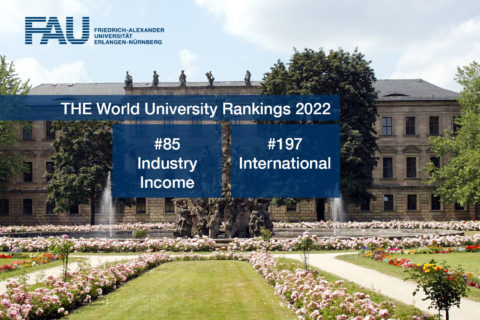
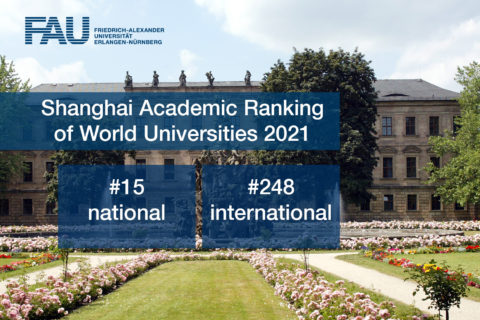
The new Shanghai university ranking has been released. In comparison to other German universities, FAU has moved up one place to number 15. On the international level, it has come in at place 248, an improvement of five places.
After time spent on trains and planes and cars you’ve made it – welcome to Germany! Many things will be different, but there’s no need to worry. Our experienced international students are here to give advice. With their help, you’ll find it easy to adapt.
The potassium channel KCNQ3 is required for our brain to generate accurate spatial maps. In mice, defects in KCNQ3 function have measurable effects on the internal navigation system. The findings of a research team including researchers from FAU recently published in Nature Communications are also relevant for Alzheimer's-type dementia research.