News

Can we inspire you with our passion for innovation in research and society? Can we inspire you to support these innovations by means of a donation? Your donation will open up new perspectives for students, researchers and for the entire FAU family. Some obstacles during the coronavirus pandemic may seem insurmountable, but we are not letting this slow us down.

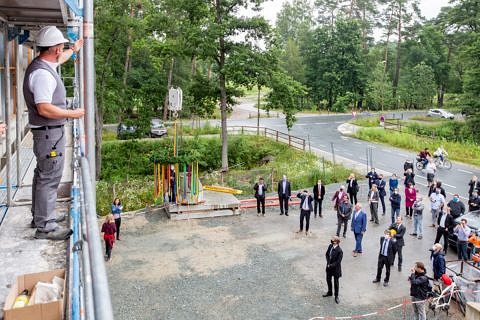
The building shell of the Erlangen Centre for Astroparticle Physics (ECAP) in Erlangen is now complete. After around 11 months of construction work, the invited guests celebrated the occasion with Klaus Holetschek, Bavarian State Secretary at the Bavarian State Ministry for Housing, Construction and Transport, and the Bavarian Minister of the Interior, Joachim Herrmann. The Bavarian and federal governments have invested more than 39 million euros in the project.

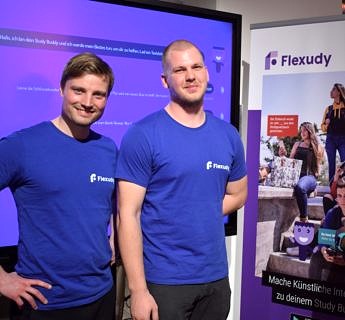
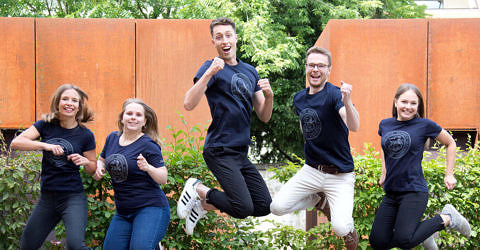
Whether for your calendar, contacts, working on documents or writing e-mails, the smartphone has long since become a mobile office for many people. Students also increasingly use their mobile devices for organising their studies and for revision. FAU alumnus Quirin Malcherzyk and Pascal Pierre, who is currently studying at FAU, have developed an app for studying called ‘Flexudy’ together with another FAU alumnus, Benjamin Albrecht, and two friends, Deli Sarsar and Steffen Süß.
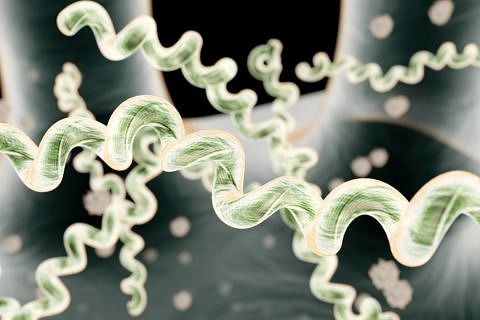
How does the immune system manage to fight invasive pathogens without damaging the body? And why does it sometimes turn against the body after all? A team from the Chair of Genetics at FAU has been exploring these questions together with the university hospitals in Erlangen and Regensburg.

United in diversity – this not only applies to the countries of the European Union, but also to its universities. Nine universities from seven countries, including FAU, have therefore come together to form the European Engineering Learning Innovation and Science Alliance (EELISA).

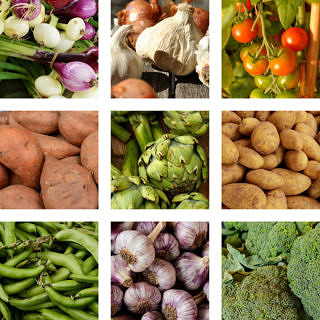
Several studies conducted by the team of researchers led by Prof. Dr. Mario Zaiss, Professorship of Immune Tolerance and Autoimmunity, suggest that a high-fibre diet can help to treat arthritis and even prevent the autoimmune disease to a certain extent.

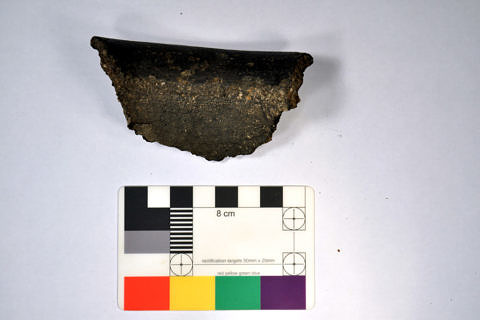
Researchers from FAU, the University of Bristol and the University of Nottingham (UK) have developed a new procedure which allows fat residues to be analysed better than ever before in vessels that are thousands of years old. Mass spectrometry imaging can be used to determine the distribution and concentration of lipids, without having to destroy the ceramics in the process.